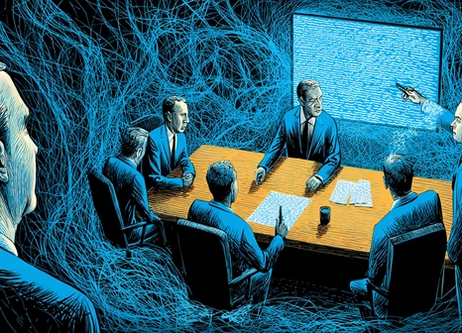
Become 'Algorithm-Proof': Build a visual identity that AI cannot (yet) copy.

Facing "Model Collapse" and AI Homogenization: How to Protect Your Brand? Discover How to Structure "Algorithm-Proof" Creative Workflows for Authenticity and Impact.
The Paradox of Synthetic Abundance
We are living in a pivotal moment for content creation. It has never been easier to produce images, text, or video. Yet, paradoxically, it has never been harder to stand out. The massive adoption of generative artificial intelligence is flooding the web with content that is visually impressive, but often strangely similar.
For marketing directors and creative project managers, the challenge has shifted. It is no longer just about producing more or faster, but about producing real. The risk is not that AI will replace you, but that it will dilute your brand identity in an ocean of "statistical averages."
Becoming an "Algorithm-Proof" brand does not mean rejecting technology. It means regaining control of the creative workflow to ensure that every published asset bears the indelible signature of strategic human intention. It means transforming AI into a powerful engine, while keeping your hands firmly on the wheel through rigorous project management.
The Era of the "Closed Loop": Understanding Model Collapse
To understand the urgency of structuring creative processes, we must look at what is happening under the hood of AI models. A recent study published in Nature highlights a worrying phenomenon: "Model Collapse."
When AI Feeds on Itself
The principle is simple but formidable: when AI models train on data generated by other AIs (rather than original human data), their ability to generate diversity and quality collapses. As explained by the MIT Technology Review, it is the digital equivalent of a photocopy of a photocopy: details blur, nuances disappear, and the result becomes a caricature of reality.
The Direct Impact on Brands
For a brand, relying solely on automation without strict supervision exposes it to this risk of blandness. Visuals become generic; texts lose their "distinctive feel."
- SEO Risk: Search engines increasingly value unique information and human experience.
- Image Risk: A visual identity "smoothed out" by algorithms struggles to create a strong emotional bond.
Strategic Note: The antidote to Model Collapse is the constant injection of "fresh," human data into your campaigns: real testimonials, photos of actual products, and art direction that dares to stray from the algorithm's beaten path.
Authenticity as a Strategic Bulwark
While AI excels at creating synthetic perfection, it still fails to perfectly simulate human imperfection and emotion. This is precisely where your competitive advantage lies.
Trust as the New Currency
According to the 2024 Edelman Trust Barometer, trust has become the most critical capital for businesses. In a world where the fake is indistinguishable from the real, consumers look for anchors. They expect brands to be beacons of truth. A brand that automates everything indiscriminately risks breaking this contract of trust.
Case Study: The Bet on the "Real"
Some brands have taken the lead by making authenticity a militant commitment. This is the case with Dove, which, through its Real Beauty campaign, pledged never to use AI to generate or modify women's faces in its advertising. This choice is not technophobic; it is strategic. It positions the brand as an entity that values the real. To succeed in this type of positioning, saying it is not enough; you need internal validation processes capable of certifying the origin and integrity of every visual.
Human-in-the-loop: The Human as Conductor
The goal is not to return to pen and paper, but to integrate AI into a collaborative workflow where the human has the final say. This is the concept of "Human-in-the-loop."
Augmented Creativity, Not Delegated
As the Harvard Business Review points out, generative AI should be viewed as a tool that enhances human creativity, not one that replaces it. It lowers the technical barrier to creation, but it raises the barrier for quality standards.
- AI proposes, the human disposes.
- AI generates variations, the human selects relevance.
- AI accelerates execution, the human guarantees emotion.
For this collaboration to work, it cannot be improvised. It must be framed by project management tools capable of supporting these new, rapid iterations.
How to Structure an "Algorithm-Proof" Workflow
Being "Algorithm-Proof" is primarily a question of organization. If your processes are chaotic, AI will only accelerate the chaos. Here is how to structure your operations to guarantee the quality and uniqueness of your productions.
1. Centralize for Better Control (Asset Management)
Dispersion is the enemy of consistency. To avoid using generic or obsolete assets, it is crucial to centralize all your media files in a single, secure space. A creative project management platform like MTM allows you to gather teams around a single source of truth. This ensures that AI (if used) is based on your guidelines and validated assets, not on random external data.
2. Versioning: Tracking Human Decisions
In an iterative creative process, knowing why a decision was made is as important as the final result.
- Version History: This allows you to backtrack if an AI generation strays too far from the brand DNA.
- Comparison: Being able to view the V1 (human) and V2 (augmented) versions side-by-side is essential for judging the real added value of automation.
3. Contextual Collaboration (Annotations and Feedback)
This is where the battle against "Model Collapse" is played out. Validation must not be a simple "OK" via email. It must be precise, contextual, and collaborative. Image or video annotation features allow art directors to pinpoint exactly which details need correcting ("This gaze lacks naturalness," "This lighting does not match our guidelines"). It is this level of detail in feedback that prevents homogenization.
4. Extended Validation (Review Links)
Authenticity is often verified by many. A robust workflow must allow for easy asset sharing for validation with external stakeholders (clients, partners, legal experts) via secure review links, without requiring them to create an account. This streamlines the validation cycle while maintaining strict control over who sees what.
The Future Belongs to Hybrid Brands
Artificial intelligence is a massive wave. You can choose to let yourself be carried by it, at the risk of ending up in the same place as everyone else, or you can learn to navigate it.
The brands that will emerge as winners from this revolution are not those that automate the most, but those that orchestrate the best. Those that use project management software not as a simple "to-do list," but as the guardian of their identity. By structuring your workflows, facilitating human collaboration, and enforcing rigorous validation, you build a visual identity that is resilient, nuanced, and profoundly human. An identity that the algorithm can admire, but will never be able to copy.
FAQ: Your Questions on AI and Creative Project Management
What is "Model Collapse" and why does it concern my brand?
It is a phenomenon where the quality of AI models degrades when they are trained on data generated by other AIs. For a brand, this means that relying solely on AI without human input risks making your content generic, repetitive, and visually poor.
How can I integrate AI into my workflow without losing my identity?
Adopt a "Human-in-the-loop" approach. Use AI for repetitive tasks or ideation (brainstorming), but keep control over art direction and final validation. Use a project management tool to track every step of human validation.
What tools should I use to manage creative content validation?
Prioritize project management platforms specialized for creatives (like MTM) that offer features for media visualization, direct annotation on videos/images, version management, and secure sharing for validation.
Will AI replace creative teams?
No, according to experts (HBR), it will change their role. Creatives will spend less time on technical execution and more time on strategy, curation, and art direction. The ability to "guide" AI will become a key skill.
Why is asset centralization crucial in the AI era?
Centralizing your assets allows you to control the data that feeds your projects. This prevents dispersion, ensures everyone uses the right files (guidelines, logos, validated visuals), and protects your intellectual property.
Sources :
- Nature: AI models collapse when trained on recursively generated data
- MIT Technology Review: AI models fed AI-generated data deteriorate
- Edelman: 2024 Edelman Trust Barometer
- Dove: The Code: Keep Beauty Real
- Harvard Business Review: Generative AI Will Enhance, Not Replace, Human Creativity