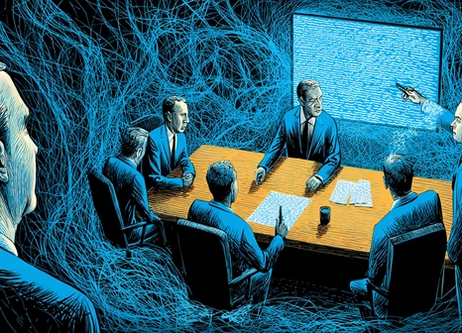
The Brand Knowledge Gap: Why Generic AI Always Drifts Off-Brand at Scale

The problem with generic AI is not model quality. It is memory. The model does not know what you approved yesterday, what you killed last year, what your brand never says.
- AI without brand memory scales inconsistency, not the brand
- Every generation becomes a roulette spin without inherited judgment
- The next AI battle is about institutional memory, not model power
The first AI pilot worked. The fifteenth deliverable already drifted. By the fiftieth, the legal team flagged a tagline you had explicitly killed two years ago. The model did not regress. It never knew. And that is the issue most marketing leaders are about to confront head-on.
A pattern is emerging across the enterprise software landscape in 2026. Several major vendors have started shipping what they are calling brand intelligence systems — products built around a single premise: the bottleneck for AI in creative work is no longer the model, it is the model's lack of brand memory. The pivot is significant because it reframes the entire conversation. For three years, the AI debate has centered on capability — which model produces the best copy, which generator creates the most photorealistic image. That conversation is largely over. The new front is whether the system knows your brand the way your most experienced team members know it.
This is the brand knowledge gap. And it is becoming the single biggest determinant of whether AI compounds value or compounds chaos inside a marketing organization.
What Generic AI Cannot See
A generic model trained on the internet has read everything and remembers nothing about your brand specifically. It can produce a competent paragraph about your product. It cannot produce the paragraph that your brand would actually approve.
The reason is structural. Large language models are stateless by default. Every call to the API starts from zero, with only what fits in the context window. Research published in 2026 confirms that even models advertising massive context windows degrade well before their stated limits, with most becoming unreliable around 130,000 tokens and showing the "lost in the middle" phenomenon where information buried inside long contexts gets attended to far less reliably than information at the edges. So even if you paste your brand guidelines into every prompt, the model is not building a relationship with your brand. It is rereading a document under pressure.
The deeper issue is that brand knowledge is not what is written in the guidelines. It is what gets approved, rejected, and refined in practice. It is the email thread where the senior brand director explained why a tagline almost worked but ultimately did not. It is the comment on version four of a campaign asset where the legal team flagged a phrase that had caused a complaint in a market three years ago. It is the unstated rule that this brand never uses certain adjectives in financial contexts, never shows a particular product configuration on social, never approves cuts under a specific runtime for hero films.
None of this lives in the guidelines. It lives in the heads of senior team members and in the trail of decisions captured — or not captured — across reviews, annotations, and Slack threads. Generic AI has access to none of it. That is what we mean by the brand knowledge gap.
Why Volume Makes the Gap Worse, Not Better
The intuitive reaction to AI is to scale production. More variants, more languages, more channels, more iterations. This works mechanically — output volume goes up. But unless the model is inheriting institutional judgment, each new asset is an independent gamble against the brand.
Industry research is converging on a striking finding here. A widely cited Lucidpress study reports that consistent brand presentation correlates with revenue increases in the range of 23 to 33 percent. Research from major DAM vendors finds that more than half of senior brand professionals at mid-sized and large companies say brand dilution costs their organizations more than 6 million dollars in lost revenue per year. The economic stakes of inconsistency are not soft. They are measurable.
What changes with AI is the velocity at which inconsistency can compound. Before AI, brand drift moved slowly because production itself was slow. A handful of off-brand assets could be caught in review. With AI, an organization can produce thousands of assets per week, each one a tiny act of brand interpretation. If the system has no memory of past decisions, the brand drifts at the speed of the production stack. The 2026 industry consensus is blunt: AI amplifies whatever fundamentals you bring to it. If your brand context is thin, AI scales thin. If your institutional judgment is uncaptured, AI scales whatever the model guesses instead.
We have written before about how brand consistency directly impacts revenue. The argument has not changed. What has changed is the speed at which the consistency curve can collapse if the AI layer has no inherited memory.
The Anatomy of Brand Memory
Brand memory is not a single thing. It has at least three layers, and most organizations are investing in only one of them.
The first layer is explicit memory — the documented guidelines. Logo placement rules, color palettes, font specifications, tone-of-voice principles. Most brands have these. AI systems can ingest them. This is the layer everyone talks about, and it is the least valuable in isolation. Guidelines describe the ceiling of what is acceptable; they do not describe how the brand actually operates.
The second layer is approved-work memory — the corpus of assets that have actually shipped, with their context. Which campaign they served. Which audience they targeted. Which performance they achieved. Which legal clearances they carried. This is where real brand identity lives, because it is what the brand has done, not what it has declared. AI systems that have access to this corpus generate outputs that look like the brand because they have learned the brand's executed taste, not its stated taste.
The third layer is judgment memory — the record of why things were rejected, refined, or escalated. This is the most valuable layer and the hardest to capture. It includes annotations, review comments, approval thread debates, and the small comments that experienced creative directors make when they push back on a draft. We've written about this in detail in methods to train your AI agent at creative quality, where the case is made that observation of human judgment is the missing input most AI training strategies overlook.
A 2026 industry analysis put it cleanly: the signals left behind as content is reviewed and refined — comments, edits, rejected versions, and final approvals — reflect how teams interpret the brand in practice, not just what the rules say. Most AI deployments capture none of this. They train on the guidelines, then wonder why the outputs feel almost right but not quite.
Why This Becomes a Boardroom Issue in 2026
The brand knowledge gap stops being a creative concern the moment AI moves from pilot to scaled deployment. And that is now happening across most large organizations.
Gartner predicts that 40 percent of enterprise applications will be integrated with task-specific AI agents by the end of 2026, up from less than 5 percent in 2025. The same firm forecasts that 60 percent of brands will use agentic AI to deliver streamlined one-to-one interactions by 2028. The volume of AI-generated brand touchpoints is about to become a different category of problem than the one most marketing leaders have planned for.
Three downstream effects follow.
First, review cycles collapse or balloon. If the AI system has good brand memory, reviewers spend their time on strategy and creative judgment, not on catching basic guideline violations. If the AI has no memory, every generation becomes a new review cycle, and the productivity case for AI silently inverts.
Second, legal and compliance exposure rises. Industry research notes that the majority of multinational brand owners now express concerns about how generative AI is used in their name. The risk is not theoretical. When an AI generates a claim that violates a regulatory commitment your brand made five years ago, the model does not know it has done so. The institutional memory exists in a folder somewhere, not in the system that produced the asset.
Third, the value of senior creative judgment becomes paradoxically more concentrated. The fewer the systems that capture institutional judgment, the more the brand becomes dependent on the small number of humans who carry it in their heads. This is fragile. It is also what we've explored in whether AI agents can truly embody a long-term brand vision — the answer depends entirely on whether the agent has access to the brand's accumulated judgment, not just its stated principles.
What Brand Memory Infrastructure Actually Looks Like
A handful of organizations are now treating brand memory as infrastructure rather than as a stack of PDFs. The pattern looks consistent across them.
The system captures context continuously, not retroactively. When a creative director rejects a draft, the rejection and its reasoning become a structured record, not a Slack message that disappears below the fold. When an asset is approved for one market and not another, the asset carries that distinction in its metadata, not in someone's memory. When a tagline is killed, the kill is recorded with the why, so the AI does not surface the same dead idea three months later for a different brief.
The system is multi-user and conversation-aware. Brand decisions are rarely the work of one person. They emerge from the interplay between creative, brand, legal, and sometimes external agencies. A useful AI layer needs to know who said what, when, and with what authority — not because it replaces those people, but because it inherits their accumulated reasoning when they are not in the room.
The system is bound to the creative workflow, not bolted on. Brand memory cannot live in a separate tool that creatives visit occasionally. It has to be embedded in the same environment where briefs are written, assets are reviewed, and decisions are recorded. Otherwise, the memory will be partial — which is to say, it will be wrong.
This is the design philosophy behind Master The Monster's agentic AI layer. Rather than treating AI as a generic generator bolted onto a project management tool, the platform was built around the idea that the AI must inherit the brand's working memory: approved assets, rejected drafts, review history, role-aware permissions, and the conversation history across multi-user reviews. We've explored how this works in practice in training an agentic AI to understand your brand tone. L'Oréal Paris, which uses Master The Monster to coordinate global campaigns across markets, operates in exactly this register: the AI does not produce on a blank slate; it inherits the brand's record of decisions.
The Limits of Brand Memory as a Concept
This thesis has a counter-argument worth taking seriously.
The first risk is calcification. A brand that captures every past decision and uses AI to enforce them risks becoming unable to evolve. Some brand drift is intentional — a strategic repositioning, a tone refresh, a deliberate break from past templates. A brand memory system that does not distinguish between "this was rejected because it was off-brand" and "this was rejected because the brand has since moved on" will hold the brand hostage to its own past. Good memory infrastructure needs forgetting mechanisms as well as remembering ones. 2026 research notes that memory staleness — when a stored fact becomes confidently wrong because the underlying reality has changed — is one of the genuinely open problems in agent memory design.
The second risk is over-investment for the wrong scale. A brand shipping fifty assets a year does not need an infrastructure-grade brand memory layer. The investment becomes strategic at the volume where human memory begins to fail, typically several hundred assets per market per year. Below that, simpler approaches work.
The third is the judgment-replacement temptation. Brand memory should make senior creative judgment more leverageable, not replaceable. If the system starts to be used as an excuse to remove senior reviewers from the loop entirely, the brand loses the very judgment the memory was supposed to scale. AI is good at producing plausible work; it is much worse at protecting strategic nuance, preserving distinctiveness, or understanding the commercial role a brand should play over time.
The Executive Take
The next phase of AI in marketing will be defined less by which model your team uses and more by what your model knows about your brand. The capability gap between models is shrinking. The capability gap between brand memory systems is widening.
The brands that will compound advantage over the next five years are the ones whose AI inherits the institutional judgment of their best people, captured continuously rather than reconstructed retroactively. The brands that will pay the inconsistency tax are the ones still asking AI to be brilliant from scratch on every brief.
Generic AI scales whatever you give it. Most organizations are giving it a PDF of guidelines and hoping for the best. The hope strategy is about to stop working at the volumes 2026 makes possible.
Request a Master The Monster demo to see how agentic AI grounded in your brand memory turns generic output into institutional creative capital → https://www.mtm.video/accelerate
FAQ
Why does generic AI drift off-brand even when guidelines are in the prompt? Because language models are stateless. They reread the guidelines every time without forming a persistent understanding of the brand. Research in 2026 shows that even long-context models attend unevenly to information, with content in the middle of a prompt followed less reliably than content at the edges. Pasting guidelines is not memory.
Is fine-tuning a model on brand data the same as brand memory? No. Fine-tuning bakes patterns into the model weights, but cannot capture ongoing decisions, rejections, or contextual judgment that happens after the training cut-off. Brand memory needs to be a live layer that updates as the brand operates, not a one-time training event.
Who owns the brand memory function inside an organization? Typically a partnership between Brand and Creative Ops, with input from Legal and Marketing. The function needs operational authority over the tooling that captures decisions, and creative authority over what constitutes a meaningful brand signal worth retaining.
Does brand memory eliminate the need for senior reviewers? No. It changes what they review. With brand memory, senior reviewers spend less time catching basic compliance issues and more time on strategic judgment. The role becomes more leveraged, not less necessary.
Where do you start if you have no brand memory infrastructure today? Begin by capturing the why, not the what. Most organizations document approved assets. Few document why specific drafts were rejected or refined. The judgment trail is where brand memory becomes useful. The infrastructure follows the data, not the reverse.
Sources
Gartner, "Top Strategic Predictions for 2026 and Beyond" — https://www.gartner.com/en/articles/strategic-predictions-for-2026
Gartner, "Gartner Predicts 40% of Enterprise Apps Will Feature Task-Specific AI Agents by 2026" — https://www.gartner.com/en/newsroom/press-releases/2025-08-26-gartner-predicts-40-percent-of-enterprise-apps-will-feature-task-specific-ai-agents-by-2026-up-from-less-than-5-percent-in-2025
Gartner, "Gartner Predicts 60% of Brands Will Use Agentic AI to Deliver Streamlined One-to-One Interactions by 2028" — https://www.gartner.com/en/newsroom/press-releases/2026-01-15-gartner-predicts-60-percent-of-brands-will-use-agentic-ai-to-deliver-streamlined-one-to-one-interactions-by-2028
Mem0, "State of AI Agent Memory 2026" — https://mem0.ai/blog/state-of-ai-agent-memory-2026
AIMultiple, "Best LLMs for Extended Context Windows in 2026" — https://aimultiple.com/ai-context-window
MarTech, "Brand consistency beats AI hype for revenue in 2026" — https://martech.org/brand-consistency-beats-ai-hype-for-revenue/