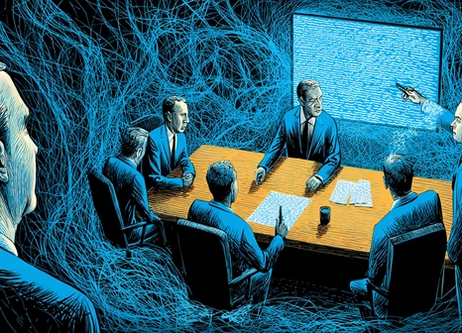
Google DeepMind Bets $75 Million on A24 to Build AI Tools That Filmmakers Actually Want

The deal does something most Hollywood-AI agreements have refused to do: it leaves the creative work alone. No library access, no training data, no production mandate. Just engineers sitting next to filmmakers while the tools get built. That structural choice — capability without surrendering control — is the model every brand and creative organization should now be studying.
- A24 keeps its library, its data, and its content fully out of Google's reach
- DeepMind gains direct access to working filmmakers shaping the tools in production
- The structure inverts the dominant "content-for-capability" model in Hollywood
A Deal Designed Around What It Refuses to Trade
The terms are unusual enough to merit attention. Google DeepMind invests approximately $75 million in A24, matching the amount Thrive Capital invested in the studio's June 2024 funding round at a $3.5 billion valuation. The partnership is multiyear and non-exclusive. A24 gets access to DeepMind's research and infrastructure. DeepMind gets engineers sitting next to working filmmakers, iterating on tools inside actual productions. What does not change hands is A24's content library, its production data, or any rights tied to its IP. There is no licensing agreement. There is no production deal. There is no mandate that anything specific must be built or shipped.
The first prototype under development is an AI storyboarding application, run out of A24 Labs — a roughly 20-person technology division led by Scott Belsky, the former Adobe executive and Behance co-founder hired in early 2025. The product is designed to surface production issues early without compressing the creative risk-taking A24 is known for. As Belsky put it to the Wall Street Journal, the goal is tools that "won't look anything like the prompted generation type of AI that people feel uncomfortable with."
Demis Hassabis framed the partnership's logic plainly: build the technology with the best minds in the field, not for them. Eli Collins, DeepMind's VP of Product, echoed the point — breakthroughs happen when you put the technology directly in the hands of the people doing the work.
That sounds anodyne until you compare it to every other major studio deal currently on the table.
What This Deal Refuses That Every Other Deal Accepts
Hollywood's AI agreements over the last eighteen months follow a near-identical pattern: the studio trades content access for model capability. Lionsgate licensed its library of more than 20,000 titles to Runway in September 2024 to train a custom video model. By late 2025, that deal had hit copyright friction, capability ceilings, and union pushback. Netflix acquired Ben Affleck's InterPositive in March 2026 in a deal Bloomberg reported could reach $600 million — the technology builds proprietary AI models from production dailies, then deploys them in post. Amazon's MGM stood up an internal AI unit. Disney signed a licensing arrangement with OpenAI for character IP while simultaneously suing MiniMax and Midjourney for copyright infringement.
Every one of these structures shares a premise: to get the AI capability, the studio gives up something fundamental about its assets — training rights, derivative rights, or both. The creative community has resisted that trade loudly. Guild negotiations during the 2023 strikes treated AI as an existential issue. Filmmakers like Guillermo del Toro and Vince Gilligan have publicly drawn hard lines against generative tooling in their work.
The A24-DeepMind structure inverts that logic. The content stays. The capability still arrives. The filmmakers shape what gets built rather than feeding the model that builds without them. Whether the distinction holds as the partnership matures is an open question — Google has not invested $75 million expecting nothing downstream, and the gravitational pull toward content access in future deal phases is real. But as a starting position, the structure represents a different answer to the question every creative organization is now being asked: how do you engage with AI without surrendering what made you worth engaging with in the first place?
The Same Question Lands on Every Brand Marketing Team
The Hollywood framing makes the deal feel distant from day-to-day marketing operations. It is not. The same structural choice now sits in front of every brand director, every head of creative ops, every CMO running content at scale.
The dominant model of enterprise AI right now mirrors the Lionsgate-Runway template. A platform shows up, promises capability, and asks for access to the brand's asset library in return — to train, to index, to fine-tune, to "personalize." The asset library is the brand. Decades of campaign archives, master files, approval histories, version trees, brand book interpretations, talent rights, regional adaptations. All of it gets vacuumed into a model whose weights, whose data lineage, and whose downstream use cases the brand cannot fully see or control. The capability is real. The trade is also real.
Most brands have not yet noticed they are making this trade. Procurement contracts get signed at the platform-purchasing level, with terms about data usage buried far below the line items executives read. By the time the trade becomes visible — when a model trained partly on the brand's assets shows up powering a competitor's campaign, or when a vendor pivots and the data lineage becomes contested — the assets are already in the model. We explored a version of this exposure pattern in our analysis of the build-versus-buy dilemma for AI capability. The same trade-off shows up at every level of the stack.
Why Generic AI Forces the Trade in the First Place
Here is the operational reason the trade keeps getting made: generic AI models cannot do brand-specific work without brand-specific data. A general-purpose generative tool will produce generic output. To get something that respects a brand's visual codes, tone of voice, color systems, talent-rights constraints, and approval logic, the model has to be exposed to the brand's actual material. That exposure is what creates the leverage problem.
The A24-DeepMind deal is an admission, by both sides, that this trade is not the only path. DeepMind gets specific feedback from real filmmakers iterating in real productions — which is a richer signal than scraping a content library. A24 gets capability without exposure. The principle holds in marketing. Brand-specific AI does not require feeding the brand's archive into a third-party model. It requires AI that operates inside the brand's environment, with context built from the workflow itself — approvals, versioning, asset metadata, briefs, annotations — rather than from licensed training data.
This is the architectural distinction between generic AI bolted onto creative work and AI that lives natively inside the creative production layer. Master The Monster's agentic AI system was built around exactly this principle. The platform's AI has context because it lives where the work happens — inside the briefs, the timelines, the annotations, the versioning history, the asset metadata, the approval flows. It does not require feeding the brand's library into an external model to behave intelligently about that library. L'Oréal Paris, Lancôme, and Helena Rubinstein use the platform precisely because creative coordination at global scale demands AI capability and asset gouvernance — not one in exchange for the other.
The same principle applies to the asset-rights dimension. How brands manage usage rights across their marketing assets is no longer a back-office compliance question. It is a strategic input to which AI platforms a brand can safely engage with — and on what terms.
What This Doesn't Solve
A nuance worth holding.
The A24-DeepMind structure is unusually clean today. That cleanliness depends on contractual discipline that has not yet been tested by time. Google has not invested $75 million expecting indefinite separation. As capability matures and commercial pressure rises, the temptation to expand access — to data, to derivative rights, to production deals — will be real on both sides. The structure is a starting position, not a permanent settlement.
There is also a capability ceiling worth naming. Tools built with filmmaker feedback but without library access will, in some technical dimensions, lag tools built with full library training. Whether A24's filmmakers find that gap acceptable in exchange for the control they keep is a judgment call only they can make. The same trade-off lands on brand teams: a brand-protective AI architecture may sacrifice some pure capability for the sake of governance and rights integrity. The right answer depends on what the brand is for, and what it stands to lose if it gets the trade wrong.
The deal also does not change the broader environment. Generic models trained on uncompensated creative work continue to scale. Lawsuits continue. Sponsored AI placements continue to expand. The A24-DeepMind structure is a counter-pattern, not a reversal of the dominant one.
What Creative Leaders Should Take From This
The lesson of the A24-DeepMind deal is not about Hollywood. It is about how an organization built on the value of its creative assets engages with AI capability without trading the assets themselves.
For brand and agency leaders, three decisions follow directly.
First, audit your current AI vendor stack for the trade. For every tool currently embedded in production, identify exactly what asset access, training rights, derivative rights, and data usage the contract permits. Most teams have never read these clauses carefully. The exposure is usually larger than the procurement team realized at signing.
Second, prefer AI capability that operates inside your creative environment rather than alongside it. AI that runs natively on the brand's briefs, timelines, versioning, and metadata — where context comes from the workflow rather than from licensed training data — preserves governance while delivering brand-specific output. This is the structural argument behind Master The Monster's positioning as the operational layer for global creative coordination.
Third, treat asset rights as a strategic input to platform selection, not a procurement footnote. The platforms a brand chooses today shape what the brand owns tomorrow. The A24-DeepMind deal is a signal that the most sophisticated players in Hollywood have already understood this. The same understanding is now overdue in marketing.
Request a Master The Monster demo → see how AI that lives inside your creative environment delivers capability without trading your asset library for it.
FAQ
Does the A24-DeepMind deal really give Google nothing in exchange for $75 million? Google gets equity in A24 at the studio's existing valuation, plus direct research access to working filmmakers iterating on tools in real productions. That access is itself valuable — feedback from professionals using AI inside actual creative work is a richer training signal than passive content scraping. Google has also positioned the deal as its first equity stake in a film studio, which carries strategic positioning value as competitors negotiate with other studios.
Why does this matter for brand marketing teams who do not produce films? Because the structural question is identical. Both Hollywood studios and global brands derive value from creative assets they own, govern, and control. Both are being asked by AI platforms to trade asset access for capability. The A24-DeepMind structure demonstrates that the trade is not the only available path — capability can be acquired without surrendering control over the underlying assets.
Is it realistic to deploy AI inside marketing operations without exposing the brand's asset library? Yes, if the AI is architected to operate inside the brand's creative environment rather than relying on the brand's library as training data. AI that draws context from briefs, workflows, versioning, annotations, and metadata — the operational layer of creative production — can deliver brand-specific output without requiring the brand's archive to be ingested into a third-party model. This is the architectural distinction between generic AI bolted on and AI built into the creative production layer.
Will this kind of structure become the new standard for studio-AI deals? Unclear. The Lionsgate-Runway template — content access in exchange for capability — remains the dominant model and is still being signed at scale. But A24's deal is the most prominent recent example of a different architecture, and other studios protective of their creative identity will likely study it carefully. The same applies to brand-AI deals: the more sophisticated buyers will increasingly distinguish between platforms that require library access and platforms that don't.
How does Master The Monster's approach to AI differ from generic AI tools? Master The Monster's agentic AI operates inside the platform's creative production environment. It draws context from the brief, the timeline, the asset versioning, the annotations, the approval flows, and the asset metadata — the operational layer of creative work. It is not a generic model that requires the brand's content library to be fed into it as training data. The capability comes from architectural integration with the workflow, not from data extraction.
Sources
- Google DeepMind official announcement: https://blog.google/innovation-and-ai/models-and-research/google-deepmind/deepmind-a24-research-partnership/
- Variety — Google Invests $75 Million in A24: https://variety.com/2026/film/news/google-a24-ai-filmmaking-tools-1236787297/
- IndieWire — A24's AI Partnership with Google Might Be Different: https://www.indiewire.com/news/business/a24-ai-partnership-google-deepmind-different-analysis-1235201463/
- The Hollywood Reporter — A24 and Google DeepMind form AI Partnership: https://www.hollywoodreporter.com/business/digital/a24-google-deepmind-ai-venture-backrooms-1236627228/
- TheWrap — Google Invests $75 Million in A24 for New AI Partnership: https://www.thewrap.com/industry-news/tech/google-a24-investment-ai-research/
- TechCrunch — Netflix may have paid $600 million for Ben Affleck's AI startup: https://techcrunch.com/2026/03/11/netflix-may-have-paid-600-million-for-ben-afflecks-ai-startup/
- TheWrap — What Happened to Lionsgate's Splashy Plan to Make AI Movies With Runway: https://www.thewrap.com/lionsgate-runway-ai-deal-ip-model-concerns/